Understanding Bundesliga Betting Odds
 Available in US
Numbers appear everywhere in sports betting, yet many bettors engage with these figures without truly understanding what they represent or how to interpret them effectively. Odds of 2.50 might prompt a bet because the potential return looks attractive, but what probability does that number imply, and does that probability match reality? These questions separate those who approach betting as pure entertainment from those who treat it as a skill-based activity where informed decisions lead to better outcomes over time. The difference between casual engagement and strategic betting often comes down to odds literacy and the discipline to apply that knowledge consistently.
Understanding odds transforms how you interact with bookmakers and how you assess betting opportunities. Rather than responding emotionally to numbers that look good or bad, you begin evaluating whether prices accurately reflect underlying probabilities. This shift in perspective opens doors to identifying situations where bookmakers have mispriced outcomes, creating value that sophisticated bettors can exploit. Without odds literacy, you are essentially navigating without a map, making decisions based on intuition that may or may not align with mathematical reality.
This guide provides everything you need to read, interpret, and evaluate betting odds effectively. We will cover the different formats used around the world, explain how to convert between them, and most importantly, demonstrate how to identify value by comparing implied probabilities to your own assessments. The Bundesliga will provide examples throughout, but the principles apply universally across sports and competitions. Mastering odds is not optional for serious betting; it is foundational.
Once you know how to calculate implied probability, you can apply this knowledge across various football betting markets and wagering options to find the best value.
Explaining Betting Odds Formats
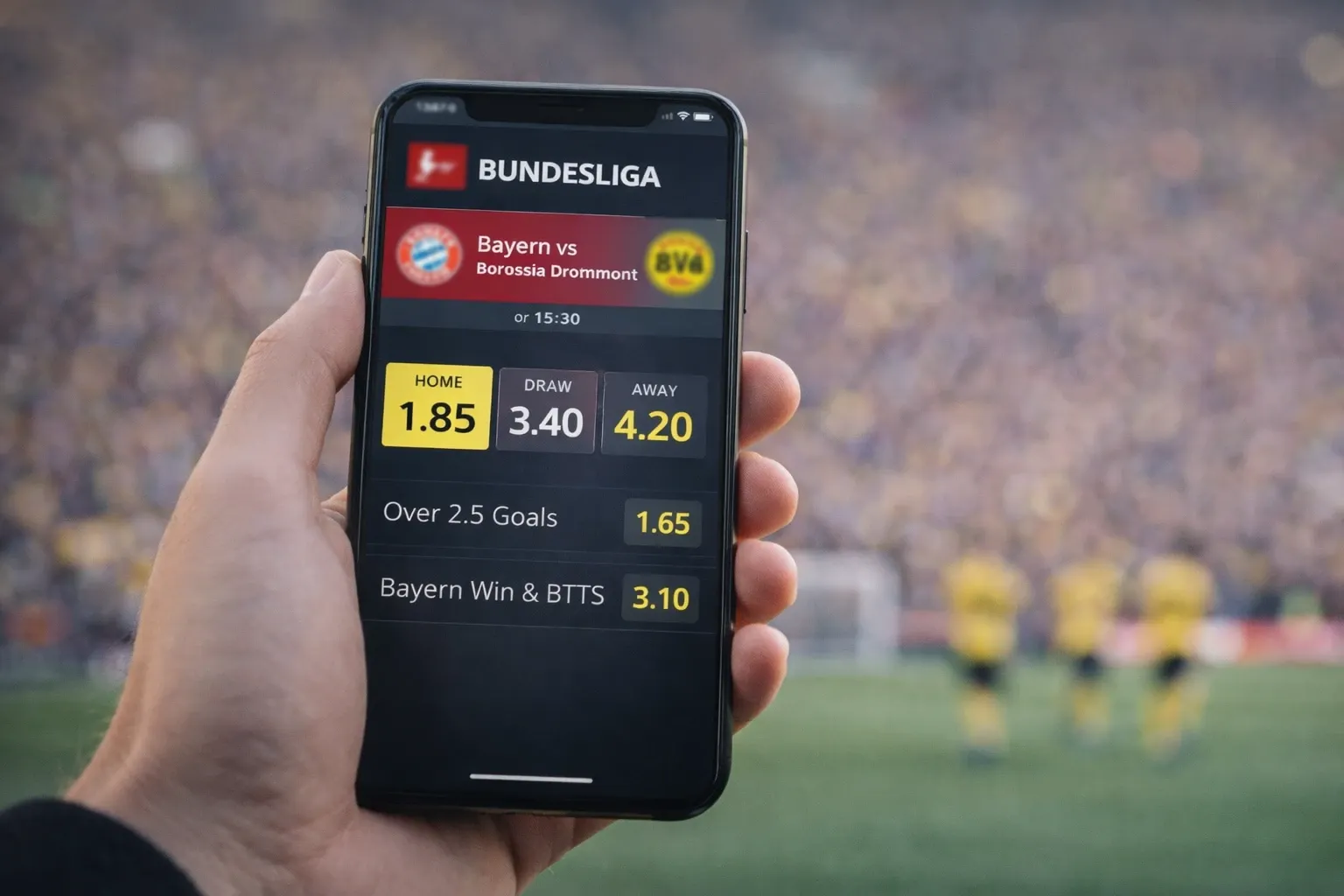
Betting odds appear in three primary formats depending on where you are in the world and which bookmaker you use. Decimal odds dominate European markets, fractional odds remain popular in the United Kingdom, and American odds prevail in the United States. Each format conveys the same underlying information but presents it differently. Understanding all three allows you to navigate any betting platform and compare odds across different sources.
Decimal odds show the total return for every unit staked, including your original stake. An odd of 2.00 means you receive two units back for every one unit wagered, representing a profit of one unit plus your original stake returned. An odd of 1.50 returns 1.50 units total, meaning 0.50 units profit. An odd of 3.00 returns three units, yielding two units profit. The format makes calculating potential returns straightforward: simply multiply your stake by the decimal odd.
The intuitive nature of decimal odds explains their popularity across global betting markets. When comparing options, higher numbers mean larger potential returns. No additional mental calculation is required to understand that 2.50 pays more than 2.00, which pays more than 1.75. This simplicity has contributed to decimal odds becoming the standard format for online betting platforms worldwide, even in markets where other formats have historical precedence.
Fractional odds express potential profit relative to stake using ratios that have deep roots in traditional betting culture. Odds of 3/1, spoken as three to one, mean you win three units profit for every one unit staked, plus your stake returns. Odds of 1/2 mean you win one unit for every two units staked. The format requires slightly more mental processing than decimals but has deep roots in British betting culture where it remains widely used.
Converting between fractional and decimal odds follows simple mathematics. Divide the first number by the second and add one. Fractional odds of 3/1 become 4.00 in decimal form because three divided by one equals three, plus one equals four. Fractional odds of 1/2 become 1.50 because one divided by two equals 0.50, plus one equals 1.50. With practice, these conversions become automatic.
American odds use positive and negative numbers centered around 100. Positive odds show how much profit you win on a 100 unit stake. Plus 200 means 200 units profit on 100 units staked. Negative odds show how much you must stake to win 100 units profit. Minus 150 means staking 150 units to win 100 units profit. The format can confuse those unfamiliar with it, but it provides quick reference for favorites and underdogs since favorites carry negative odds and underdogs carry positive odds.
Converting American odds to decimal requires different formulas for positive and negative values. For positive odds, divide by 100 and add one. Plus 200 becomes 3.00 because 200 divided by 100 equals two, plus one equals three. For negative odds, divide 100 by the absolute value and add one. Minus 150 becomes approximately 1.67 because 100 divided by 150 equals roughly 0.67, plus one equals 1.67.
Most online betting platforms allow you to select your preferred odds format in account settings, making familiarity with all three less critical than it once was. However, understanding the underlying mathematics ensures you can navigate any situation and verify that conversions are accurate. Some bettors develop preferences for particular formats based on how they conceptualize probability and value, though the information conveyed remains identical regardless of presentation.
From Odds to Implied Probability

The crucial insight about betting odds is that they represent bookmaker assessments of probability. Decimal odds of 2.00 imply a 50% chance of the outcome occurring. Odds of 4.00 imply a 25% chance. This relationship between odds and probability is not arbitrary but mathematical, and understanding it transforms how you evaluate betting opportunities.
The formula for converting decimal odds to implied probability is straightforward: divide one by the decimal odd and multiply by 100 to express as a percentage. Odds of 2.00 convert to 50% because one divided by two equals 0.50, which as a percentage is 50%. Odds of 1.50 convert to approximately 67% because one divided by 1.50 equals roughly 0.67. Odds of 3.00 convert to approximately 33% because one divided by three equals roughly 0.33. Memorizing these common conversions speeds analysis considerably.
This conversion reveals what bookmakers believe about match outcomes. When Bayern Munich is priced at 1.25 to beat a relegation candidate, the bookmaker implies roughly 80% probability of Bayern winning. When Borussia Dortmund faces another top-four contender at odds of 2.40, the implied probability is approximately 42%. These numbers provide a baseline against which you can compare your own probability assessments.
The inverse conversion, from probability to fair odds, is equally important. If you believe an outcome has a 60% chance of occurring, the fair odds are approximately 1.67, calculated by dividing one by 0.60. If you believe an outcome has a 40% chance, fair odds are 2.50. When bookmaker odds exceed your fair odds calculation, you have potentially identified value.
Understanding implied probability also reveals the bookmaker margin, sometimes called the overround or vigorish. In a fair market with no margin, the implied probabilities of all possible outcomes would sum to exactly 100%. In reality, bookmakers build in margins by setting odds that sum to more than 100%. A typical Bundesliga match might have odds that imply 105% total probability, meaning the bookmaker takes roughly 5% regardless of outcome.
Calculating the margin requires converting all odds to implied probabilities and summing them. If home win odds are 2.10 implying 47.6%, draw odds are 3.40 implying 29.4%, and away win odds are 3.50 implying 28.6%, the total is 105.6%. The 5.6% above 100% represents the bookmaker’s built-in edge. Lower margins indicate more competitive odds, which is why comparing across bookmakers matters for serious bettors.
Different markets carry different margins. Match result markets, which attract the most recreational money, often have higher margins than Asian handicap markets favored by sharp bettors. Obscure prop bets may have margins exceeding 10% because limited betting volume allows bookmakers to maintain wider spreads without losing customers. Understanding where margins are higher helps identify markets where overcoming the built-in disadvantage is more difficult.
The Concept of Value Betting
Value is the central concept separating profitable betting from gambling. Value exists when the odds offered exceed what probability justifies. If an outcome has a 50% true probability but bookmaker odds imply only 45% probability, the odds of approximately 2.22 offer value compared to fair odds of 2.00. Consistently identifying and betting on value opportunities is theoretically the only path to long-term betting profit.
The challenge lies in determining true probabilities. Bookmakers employ teams of analysts and algorithms to set odds that accurately reflect probabilities. Their assessments are not perfect, but they are informed by substantial resources that individual bettors cannot match. Believing you have found value requires confidence that your probability estimate is more accurate than the bookmaker’s, at least in specific situations where you possess relevant knowledge or insight.
Different approaches to finding value suit different bettors. Some develop statistical models that process historical data to generate probability estimates. Others rely on deep knowledge of specific leagues or teams that allows them to identify factors bookmakers might underweight. Still others focus on market dynamics, exploiting situations where public money pushes odds away from true probability. None of these approaches guarantees success, but each provides a framework for systematic value identification.
The Bundesliga offers particular opportunities for value-focused bettors. The league’s statistical transparency means data is readily available for model building. Its distinctive characteristics, including the attacking style, the 50+1 ownership rule effects, and the winter break dynamics, create patterns that generic models might miss. Bettors who develop specialized Bundesliga knowledge can potentially identify value that those applying generic approaches would overlook.
Understanding value also requires recognizing when value does not exist. Not every bet offers positive expected value, and the discipline to abstain when prices are unfavorable is as important as the skill to identify favorable opportunities. Many recreational bettors lose money not because they cannot find value but because they bet regardless of whether value exists.
Expected value calculations formalize the value concept mathematically. Expected value equals the probability of winning multiplied by the potential profit, minus the probability of losing multiplied by the stake. A bet with positive expected value is theoretically profitable over infinite repetitions, while negative expected value bets drain bankroll over time. The formula provides an objective framework for evaluating betting opportunities.
Consider a concrete example. You believe Bayern Munich has a 75% chance of winning a particular match, while bookmaker odds of 1.40 imply approximately 71% probability. Your expected value calculation: 0.75 multiplied by 0.40 profit equals 0.30, minus 0.25 multiplied by 1.00 stake equals 0.25. The net expected value is 0.05 units per unit staked, or 5% positive expectation. If your probability estimate is accurate, this bet profits over time.
The crucial caveat is that your probability estimate must be accurate for expected value calculations to be meaningful. Overconfident probability estimates lead to perceived value that does not actually exist. Developing calibrated probability estimates requires extensive analysis, honest self-assessment, and willingness to learn from outcomes over time. The bettors who profit long-term are those who combine good probability estimation with disciplined execution.
Odds Movement and Market Dynamics

Betting odds are not static. They move constantly in response to betting action, new information, and bookmaker risk management. Understanding why and how odds move provides insight into market sentiment and can inform betting timing decisions.
Opening odds represent bookmaker initial assessments before markets open to the public. These lines reflect internal analysis and are typically available to limited sharp bettors before becoming widely accessible. Opening odds matter because they establish baselines against which subsequent movement can be measured. Significant differences between opening and closing lines reveal how market opinion shifted as information accumulated.
Early money from professional bettors often moves opening odds significantly. Bookmakers respect sharp action because these bettors have demonstrated long-term profitability. When sharps consistently back one side, bookmakers adjust odds to balance their exposure and reflect the new probability information. This early movement occurs before most recreational bettors place their wagers.
Public money flows closer to match time and typically favors favorites, home teams, and popular clubs. This recreational action can push odds in predictable directions, sometimes creating value on the opposite side. When public money drives a favorite’s odds lower without corresponding probability changes, the underdog or draw may offer value. Recognizing these patterns requires tracking how odds move across the betting week.
Closing line value has emerged as an important concept among serious bettors. If you consistently bet at better odds than the closing line, meaning the final odds available before kickoff, you are likely making sound judgments. The closing line represents the market’s most efficient assessment after all information is absorbed. Beating it regularly suggests genuine skill rather than luck.
Team news dramatically affects odds in predictable ways. Injury announcements for key players move lines immediately as bookmakers reprice probabilities. Suspension news, tactical leaks, and lineup announcements all trigger adjustments. Bettors with information advantages, whether through early access or superior interpretation, can capture value before markets fully adjust.
Weather conditions, referee appointments, and other factors also influence odds, though typically to lesser degrees. Bookmakers incorporate these elements into their pricing, but the adjustments may not perfectly reflect true probability impacts. Bettors who understand how specific factors affect Bundesliga matches can potentially identify situations where bookmaker adjustments are insufficient or excessive.
Comparing Odds Across Bookmakers

Odds comparison is not merely about finding the highest number but about systematically ensuring you receive the best available price for every bet. The cumulative impact of consistently better odds compounds significantly over time, turning marginal improvements into meaningful profit differences.
Different bookmakers set different odds for the same events. These differences arise from varying analytical approaches, different customer bases, and distinct risk management strategies. Some bookmakers specialize in particular sports or leagues, often offering better odds in their areas of focus. Others cater to sharp bettors and maintain tighter margins across the board. Understanding these distinctions helps identify which bookmakers to check for specific types of bets.
Using multiple bookmaker accounts allows you to capture the best available odds on every selection. If Bookmaker A offers 2.10 on Bayern Munich while Bookmaker B offers 2.15, the 2.4% odds improvement might seem trivial. However, across hundreds of bets, that improvement translates to meaningful additional returns. Professional bettors routinely maintain accounts at dozens of bookmakers to maximize odds capture.
Odds comparison websites aggregate prices from multiple bookmakers, making comparison straightforward. These tools show which bookmaker offers the best odds for any selection and calculate how much additional value the best price provides. Some tools also track historical odds movement, providing insight into how lines have shifted since opening.
Betting exchanges offer an alternative to traditional bookmakers. On exchanges, bettors set their own odds and match with others who take opposing positions. Exchange odds are often more competitive because they lack traditional bookmaker margins, instead charging small commissions on winning bets. The trade-off is potentially lower liquidity, meaning large bets may not be fully matched.
The practical reality is that serious bettors need multiple accounts and the discipline to shop for odds before every bet. This process adds time and complexity but represents one of the clearest paths to improving long-term results. Those unwilling to compare odds are leaving money on the table that more diligent bettors will capture. The extra minutes spent comparing prices often yield better returns than hours spent analyzing matches without subsequent odds optimization.
Applying Odds Understanding to Bundesliga Betting

The Bundesliga’s characteristics create specific odds patterns that informed bettors can navigate strategically. Understanding these patterns transforms generic odds knowledge into actionable Bundesliga betting intelligence.
Bayern Munich’s dominance creates persistent low odds that challenge value identification. Their match result odds frequently fall below 1.30 against weaker opposition, implying probabilities above 77%. Whether these prices accurately reflect true probability requires assessment of specific match circumstances rather than blanket assumptions about Bayern’s quality. Sometimes Bayern at 1.25 represents poor value; occasionally it represents fair pricing that simply offers limited return potential.
The league’s attacking nature affects goal market odds systematically. Over 2.5 goals odds are typically lower in the Bundesliga than in more defensive leagues because bookmakers recognize the higher scoring tendency. Finding value requires identifying fixtures where goalscoring probability exceeds even the adjusted Bundesliga baseline. Matches between two attacking teams with defensive vulnerabilities often present such opportunities.
Home advantage varies significantly across Bundesliga clubs, and odds should reflect these variations. Clubs like Borussia Dortmund and Union Berlin show dramatic home and away performance splits that inform appropriate pricing. When bookmaker odds do not adequately account for these splits, value opportunities emerge.
Mid-table matchups often receive less pricing attention from bookmakers, who concentrate resources on high-profile fixtures. This allocation creates potential inefficiencies in odds for matches between less glamorous clubs. Bettors with specialized knowledge of these teams can potentially identify mispricing that casual analysis would miss.
The winter break creates predictable uncertainty that affects odds for early-season second-half matches. Teams return at varying preparation levels, and bookmakers must price this uncertainty into their odds. Historical analysis of post-break performance can inform whether current pricing adequately reflects the increased variance.
European competition fatigue affects specific clubs at specific times, creating odds adjustment opportunities. When a Bundesliga club plays Thursday in Europa League and Saturday in domestic competition, their odds should reflect diminished performance probability. If adjustments are insufficient, value exists on opposing sides.
Promoted teams present interesting odds challenges throughout the season. Initial pricing may underestimate teams that are well-prepared for top-flight competition or overestimate teams that will struggle. As the season progresses and information accumulates, odds adjust, but early-season opportunities exist for those who assess promoted teams accurately.
What emerges from comprehensive odds understanding is the ability to evaluate any Bundesliga betting opportunity on its merits. Rather than reacting to numbers emotionally, you assess whether prices adequately reflect probabilities given everything you know about the match, the teams, and the circumstances. This analytical approach, applied consistently over time, provides the foundation for informed betting that maximizes chances of long-term success while acknowledging the inherent uncertainty that makes outcomes impossible to predict with certainty. The numbers tell a story, and those who learn to read that story gain advantages that casual observers simply cannot access.
Discover expert insights and daily tips at the top Bundesliga betting platform.
